Ailanthus altissima (Tree-of-Heaven, ToH) is listed as invasive in Connecticut. In
addition to forming large clonal colonies that crowd out native trees and understory
plants, ToH produces allelopathic chemicals that inhibit the germination of most
native plants. Mature female ToH trees can produce more than 300,000 winged
seeds (samaras) each year that disperse by wind to initiate new colonies. ToH also
serves as a preferred host for spotted lanternfly (Lycorma delicatula), a sap-
sucking invasive Asian planthopper that has been expanding its range into New
England, threatening wine grapes, fruit orchards, timber trees and other
economically important crops.
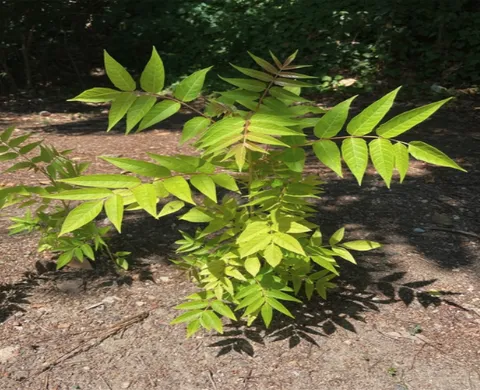
Small tree-of-heaven. Ryan Bohannon, NC State University CC BY 4.0
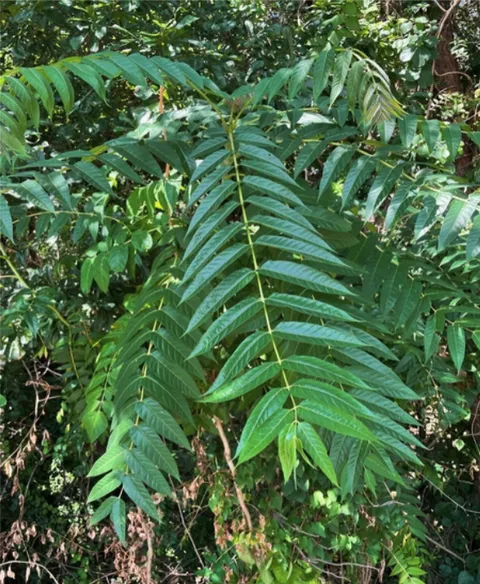
Tree-of-heaven foliage. Ryan Bohannon, NC State University CC BY 4.0
The preferred herbicide for ToH is triclopyr triethylamine salt (aka “triclopyr
amine,” brand name Garlon 3) which can be purchased as a concentrated solution
where it comprises 8% to 44% of total ingredients. Triclopyr is selectively toxic to
dicots (woody and most broadleaf plants) at concentrations that do not harm
monocots (grasses and related plants) and is safe for people and animals. Read the
product labels carefully to ascertain that triclopyr is the ONLY active herbicidal
ingredient and that the concentration is suitable for use on ToH – some ready-to-
use products are too dilute. Peter uses 44% solution without dilution for ToH trunk
treatment. Concentrated solutions can be purchased online;
When to control ToH? Treatment is most effective once ToH trees have fully
leafed out in late spring until they begin to go dormant (foliage color change) in
mid-fall. In southern New England, this is typically late June through mid-October.
Within this seasonal window, earlier treatment (before July 1), especially of female
trees, can reduce or prevent seed production.
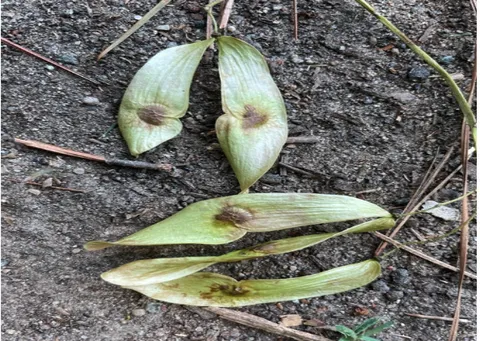
Each samara (fruit) is composed of a flat, twisted wing with a seed near its center. Ryan Bohannon, NC State
University CC BY 4.0